Most homeowners who call about stone wall repair ask some version of the same question: can this wall be fixed, or does it have to come down? It is the right question, and the answer usually sits in plain sight once you know what to look for. Some damage is cosmetic and stays that way for decades. Other damage means the wall is moving, and a wall in motion does not stop on its own.
The difference is readable once you know where to look: which problems a repair handles, which ones point to a rebuild, what each path involves, and why the cheaper-looking option is not always the cheaper one over time.

The Deciding Factor Is Structural Condition, Not Age
Age alone tells you very little about a stone wall. New England is full of fieldstone walls that have stood for well over a century and need nothing but an occasional reset stone. It also has twenty-year-old walls that are already leaning, because they were built on a poor base or without drainage behind them.
What matters is whether the wall is still doing its job as a structure. A sound wall carries its own weight down through its base in a stable line. When that line is intact, damage tends to be local: a failed joint here, a loose stone there. When that line is broken, the whole wall starts to move, and no amount of surface work will hold it.
So the useful question is not "how old is this wall?" It is "is this wall stable, with local damage, or is it moving?" Everything below follows from that distinction.

Damage a Repair Handles
Certain problems are local by nature. Fixing them restores the wall without touching the parts that are still sound.
Loose or dislodged stones are the most common. Frost, foot traffic, and time work individual stones out of position, especially capstones along the top. A mason resets them, packing and seating each one so it locks against its neighbors again. On a dry-laid wall this is routine maintenance, the kind of work the wall was designed to accept.
Failed mortar joints are the mortared wall's version of the same problem. Mortar is softer than stone on purpose: it takes the weathering so the stone does not. When joints crack, crumble, or wash out, the fix is repointing, which means raking out the failed mortar to sound depth and packing in new mortar that matches the original. Done correctly, repointing can add decades of service without disturbing a single stone.
Small, stable bulges can also fall on the repair side of the line, with a caveat. If a short section has shifted slightly but the movement has stopped, a mason can take down just that section and relay it, tying the new work into the sound wall on either side. The caveat is the word "stable." A bulge that is still growing belongs in the next section.
The common thread in all of these: the damage has a boundary. The wall around the problem is still plumb, still tight, still carrying its load.
Damage That Points to a Rebuild
Other symptoms tell you the wall is failing as a structure, not just weathering at the surface.
A leaning section is the clearest signal. Walls lean because something below or behind them has moved: the base has settled unevenly, water is pushing from behind, or the wall was never battered (tilted slightly into its load) to begin with. Once a wall is out of plumb, gravity works against it a little more each season. Patching the visible gaps does nothing about the lean itself.
Spread or settled footings show up as long horizontal cracks, sections that have dropped relative to their neighbors, or a wall that looks like it is slowly sitting down into the ground. The problem here is under the wall, so any fix that starts above grade is treating a symptom. The affected run typically needs to come down so the base can be rebuilt on proper compacted material.
Root heave is the third common culprit. A tree root growing under or against a wall lifts and displaces stones season after season. Resetting the stones without addressing the root just schedules the same repair again in a few years. Depending on the tree and its placement, the honest fix may involve rerouting the wall, removing the root, or rebuilding that section with the root's growth accounted for.
One more test worth applying to any of these: is the damage still progressing? A photo taken today and compared against the same spot in six months settles a lot of arguments. Cracks and bulges that are growing mean movement, and movement means the rebuild conversation.
What Each Path Involves
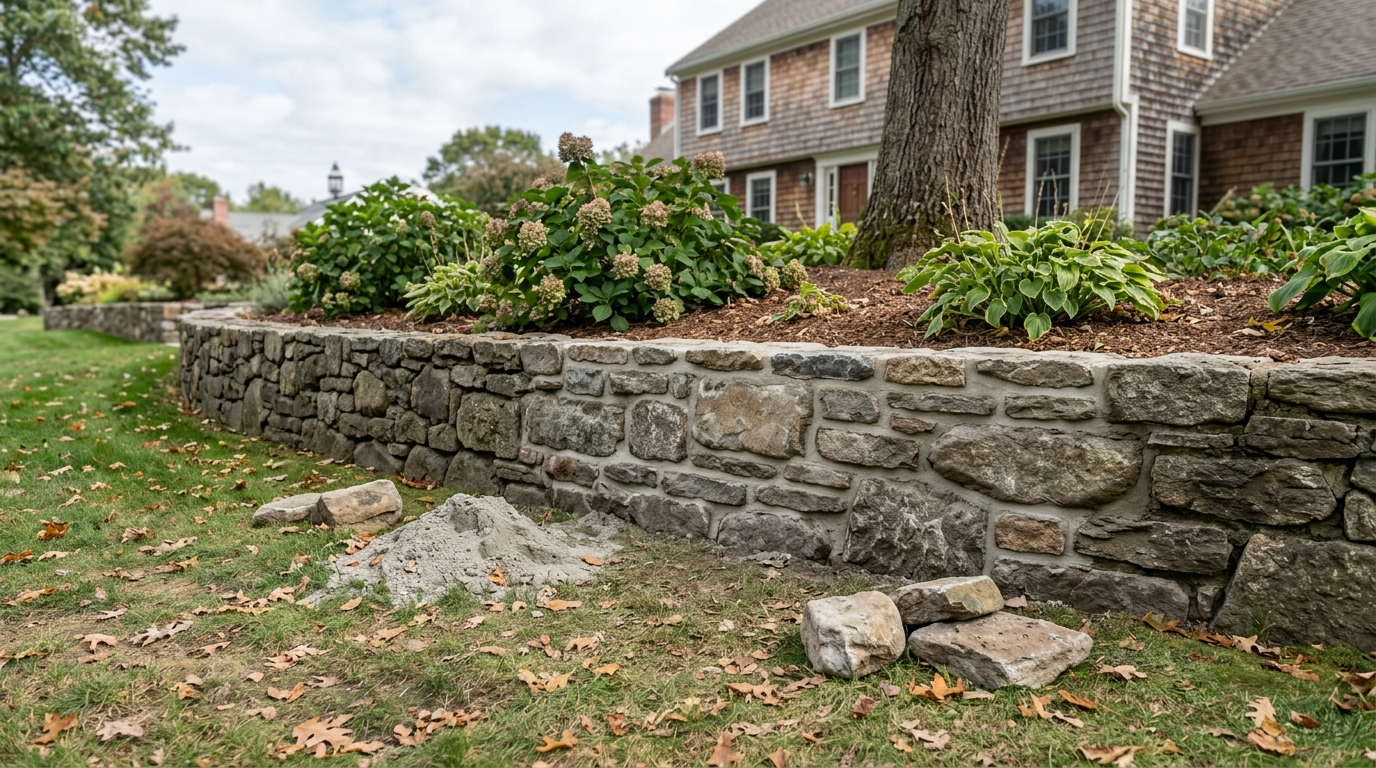
Repair work is targeted. For repointing, the mason rakes joints, mixes a compatible mortar, packs and tools the new joints, and keeps the work damp while it cures. For resets and small relays, the affected stones come out, the bedding is corrected, and the same stones go back in. Most repairs finish in a day or two, and the wall keeps its original material and character throughout.
A rebuild is a different scope of work. The failed section comes down completely, usually with the stones sorted and saved for reuse. The base gets corrected: excavated, brought up with compacted gravel, and in the case of retaining sections, backed with drainage stone so water stops pushing on the wall. Then the wall goes back up, course by course, with proper batter and through-stones tying the faces together. A rebuilt section, done this way, is effectively a new wall built from the old wall's stone.
Partial rebuilds sit between the two, and they are common. A wall rarely fails along its entire length at once. Taking down and rebuilding the thirty feet that moved, while repointing or simply leaving the sound remainder, is often the proportionate answer.

The Cost Logic: Why Rebuilds Often Beat Repeated Patching
Repair is cheaper than rebuilding for any single visit. That is exactly what makes the cost of repairing a stone wall misleading when the underlying problem is structural.
Patching a moving wall buys time, not resolution. The lean or settlement continues, the patch opens back up, and each return visit costs money without changing the outcome. Three rounds of patching over several years can approach what the honest partial rebuild would have cost the first time, and at the end of it the wall still needs the rebuild.
The reverse is also true, and worth stating plainly: rebuilding a wall that only needed repointing is money spent on a problem you did not have. This is why the diagnosis matters more than the price of either fix. The right spend is the one matched to what the wall is actually doing.
A reasonable rule: pay for repair when the damage has a boundary and the wall around it is sound. Pay for rebuild, in whole or in part, when the wall is moving, because that is the only spend that stops the movement.
Getting a Wall Assessed
Reading a wall accurately takes someone who has taken a lot of them apart. An experienced mason checks plumb along the run, probes the joints, looks at what is happening at the base and behind the wall, and can usually tell you on the spot which category your damage falls into and where the repair-versus-rebuild line runs on your specific wall.
That assessment should produce more than an opinion. A written estimate that names which sections need what, and why, gives you something to plan and budget against, and something to compare if you get a second opinion.
If your wall is showing any of the symptoms above, request a wall assessment and written estimate. You will know what the wall needs, what it will cost, and which spend actually solves the problem, before you commit to either path.